The Myth of the All-Hands Effort
Neighborhood cleanup roles make it clear where to start, what to finish, and how to hand work off, so neighbors can contribute without guessing.
Neighborhood cleanup roles make it easier to start than a general call to “pitch in.” When neighbors arrive at a courtyard with no task boundaries, they may wait for direction, duplicate work, or leave unsure whether they can help briefly. Set a shared goal, then give each task a clear place to begin and a visible endpoint.
Think of the plan as a set of labeled drawers: each person can see where a contribution fits without rummaging through a pile. For a courtyard cleanup, one neighbor might welcome arrivals, another might manage gloves and bags, and others might handle separate areas. The roles coordinate the work; they do not rank the people doing it.
Clear starting points
“Everyone help clean up” names a goal, not an action. People may not know which areas are included, which jobs are appropriate, or whether someone has already claimed a task. A vague invitation makes each arrival do the planning.
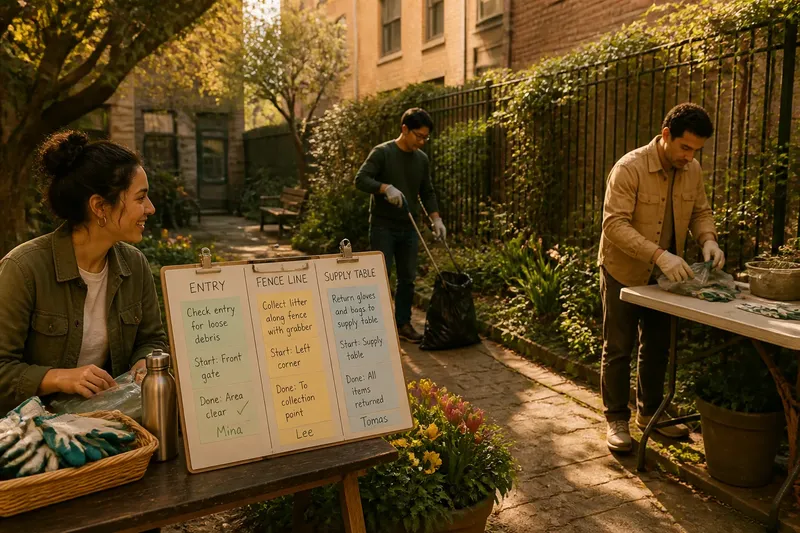
Before the gathering, name a few visible tasks. For example, list “entry,” “garden edge,” and “supply table” on a sheet of paper. Give each task a starting location and a clear finish, such as collecting loose litter along the fence or returning unused tools to the table.
Show which roles remain open with a small sign or a brief greeting. Someone arriving late should be able to see what needs doing without interrupting the group or explaining why they have limited time.
Visible task ownership
When nobody can see what has been claimed, several people may start the same job while another goes untouched. Mark ownership on a task board with a name or a simple checkmark. If a section is finished, its volunteers can ask where help is still needed rather than guessing.
Make handoffs explicit when tasks depend on one another. The person gathering branches can place them at a designated collection point; another person can take responsibility for the next agreed action. Keep ordinary decisions with the people doing the work so every small change does not require a coordinator’s approval.
Separate tasks that sound similar but have different responsibilities. “Keep the supply table stocked and return unused tools” is a bounded job; “supervise everyone” is not. If a choice affects the whole group, such as changing the work area, pause for a quick check with participants.
Fair role assignment
Separate roles are useful only if neighbors can understand and accept them fairly. If familiar volunteers quietly assign work, or if one task carries more authority, a task list can reproduce a pecking order. Describe each job plainly, including its demands, and let people choose when feasible.
Rotate routine tasks across gatherings instead of leaving the same person with the least popular job by default. State any real requirements, such as permission to enter a restricted area or familiarity with a tool. If a role requires something a volunteer does not have, offer a different useful task without asking for personal explanations.
Say you are organizing a courtyard cleanup with three neighbors: Mina has a short visit, Lee is comfortable using a litter grabber, and Tomas would rather not handle tools. Put “collect litter along the fence with the grabber,” “check the entry for loose debris,” and “return gloves and bags to the supply table” on the task board. Mina chooses the entry check and marks it complete before leaving; Lee takes the fence; Tomas handles the supplies. The result is a finished entry, a clear boundary for Lee’s work, and a visible supply handoff, without making any neighbor justify a preference.
Bounded work periods
A role without a stopping point can make a brief visit feel impossible. Break a larger job into portions that can be finished and handed off. Instead of “manage supplies,” separate setting out equipment, noting what is missing, and putting shared items away.
Explain how to finish a role: return the grabber to the table, mark an area complete, or tell the welcome person you are leaving. If a volunteer cannot finish a task, the next person should be able to tell what remains without a long explanation.
Common role questions?
How many roles does a small group need?
Use only enough roles to prevent real confusion; a small gathering may need a greeter, a task board, and volunteers assigned to separate areas. Add another role only when a specific task is being missed or delayed.
What if nobody takes the coordinator role?
Make coordination a bounded task, such as welcoming arrivals and updating the board, rather than an open-ended duty to direct everyone. If nobody takes it, simplify the plan so volunteers can begin with clear tasks and safe boundaries.
Can someone join without choosing ahead?
Keep a visible task open and name a person who can show its starting point. A neighbor should be able to join after arriving without signing up or learning the whole plan first.
When should volunteers work in pairs?
Pair people when a particular task is easier to explain or share that way, but do not require pairs for every job. Keep an individual task available for someone who prefers to work alone.
A lighter plan
Too many assigned roles and check-ins can make a simple gathering harder to understand. Give a short explanation at the start: state the shared purpose, show where work begins, point out open tasks, and explain how to finish or hand one off. Put extra details on a small task card or sign.
Before inviting neighbors, use this checklist. For each item, check the observation and choose the action that follows:
- Can a late arrival see an open task on the board? If yes, leave it open for walk-ins; if no, add a plainly named task and its starting point.
- Does each task show where it starts and what counts as finished? If yes, keep the wording; if no, rewrite it around a location and observable endpoint.
- Can a volunteer leave after completing a portion? If yes, state the handoff; if no, divide the job into smaller portions before inviting the group.
- Are routine or less popular tasks assigned by default to the same neighbor? If no, keep the rotation; if yes, offer the task openly and rotate it at the next gathering.
- Does a task require a tool, permission, or local disposal instruction? If yes, state the relevant limit and ask a qualified person if safety or permission is unclear; if no, keep the task description simple.
- Can volunteers tell who to ask about a change that affects everyone? If yes, keep that contact visible; if no, name a person for group-level questions without routing every small decision through them.
Closing the work
Include the final handoff in the plan. One person can return shared equipment, another can check that the entry remains clear, and someone can tell the group what was completed and what still needs attention. If work remains, name who will decide the next action or when the group can revisit it.
After the cleanup, ask which role was confusing, missing, or difficult to hand off. Use that answer to adjust the next neighborhood cleanup roles. A clear task lets a neighbor choose where to help, finish a useful part, and leave the shared space in a known state.