The Invitation Is Part of the Gathering
A clear gathering invitation helps neighbors judge the purpose, timing, and ways to join, so they can decide comfortably whether the event fits.
A clear invitation can decide whether a neighborhood gathering feels open to you before anyone arrives. State the purpose, time, place, and ways to take part, and a neighbor can make a real decision instead of guessing what the event requires.
Imagine a resident named Mara wants to bring neighbors together to swap garden seedlings and talk about what grows well nearby. She has access to a community room and a folding table, but the first draft of her invitation says only, “Seedling exchange this Saturday—everyone welcome.” It sounds friendly, yet it leaves practical questions unanswered: Is swapping required? Can someone come without plants? How long will the gathering last? Mara’s revisions show how an invitation can make the gathering more usable before it begins.
A plain purpose
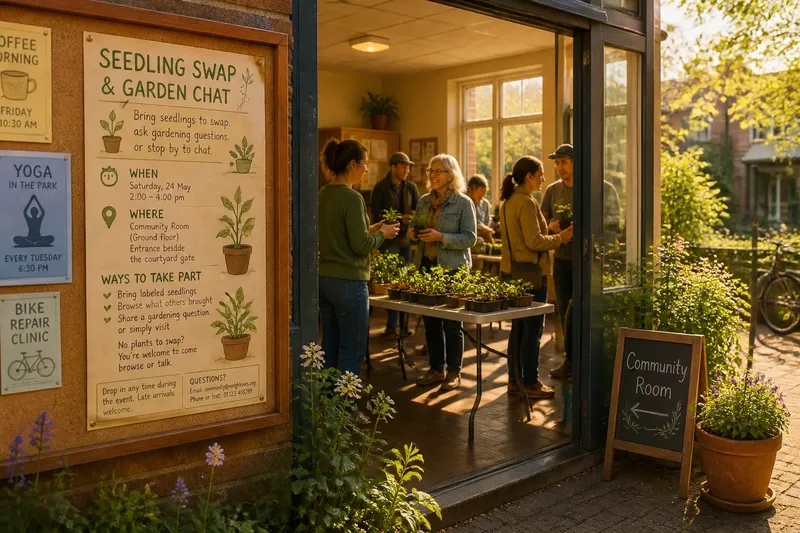
Mara first names what people will do: “Bring seedlings to swap, ask gardening questions, or stop by to chat.” That sentence gives the gathering a shape without making it sound like a club for experienced gardeners. A neighbor without a garden can see that conversation is welcome too.
A purpose should be specific enough to set expectations, but not so narrow that it excludes people who might enjoy a related role. “Community gardening event” could mean anything from planning a shared plot to hauling soil. “A casual seedling swap and gardening conversation” tells readers what to picture and lets them decide whether it suits them.
It also helps to say what the gathering is not asking people to do, when that could be unclear. Mara adds that there will be no formal presentation and no need to bring anything. This prevents a reader from assuming the event requires expertise, a contribution, or a commitment to future work.
A usable time and place
“Saturday afternoon” is not enough for someone arranging a ride, coordinating with a family member, or fitting a visit between errands. Mara gives a start time and an end time, then names the community room and its entrance from the side courtyard. The invitation now offers a usable plan rather than a vague window.
She includes a short note about the place: the room is on the ground floor, and the entrance is beside the courtyard gate. If readers might have trouble identifying the location, a familiar landmark can help. Keep directions brief, and do not make people contact the organizer just to learn where to go.
A gathering’s time can also signal its expected rhythm. An announced end time reassures a neighbor who can only stay briefly that leaving early is acceptable. If the event is informal and people may arrive at different times, say so directly; do not make readers infer that from a casual tone.
Ways to take part
Mara realizes that “bring seedlings” still sounds like an entry requirement. She changes the invitation to list several ways to participate: bring labeled seedlings, browse what others brought, share a gardening question, or simply visit. The wording makes the exchange more accessible without disguising its main activity.
These options matter because neighbors arrive with different amounts of time, confidence, and experience. One person may want to chat for a few minutes; another may be eager to compare tomato varieties. An invitation does not need to predict every preference. It should make clear that there is more than one acceptable way to belong in the room.
Imagine a neighbor has no seedlings and is unsure whether to attend. Mara’s revised message says, “No plants to swap? You’re welcome to come browse or talk.” The neighbor can now expect a visit that does not depend on bringing an item, and can choose to stop in without worrying about breaking an unstated rule.
Questions before arrival?
Should guests RSVP?
Ask for an RSVP only if it helps with a real planning need, such as arranging access or preparing a limited number of materials. If people can simply drop in, say that instead of leaving them to wonder whether a reply is required.
What if someone arrives late?
Say whether late arrivals are welcome, especially if the gathering has a short opening activity. For Mara’s informal swap, the invitation can explain that people may drop by during the stated time.
How should access needs be handled?
Give practical information you know, such as the entrance location or whether seating will be available. Invite people to contact the organizer about a particular access question, and provide a reply method they can use comfortably.
Should the invitation ask people to bring something?
Make any requested item optional or required in plain terms. If bringing something is not necessary to join, say so directly; if a contribution is central to the activity, explain that before people commit.
A channel that reaches neighbors
Mara posts the invitation on the community-room noticeboard and shares the same wording in the neighborhood email group. She asks a nearby shop owner whether a small flyer can go by the entrance, where local residents already stop. Repeating one clear message across familiar channels helps people encounter the same expectations, rather than a shortened version that drops key details.
She keeps the text easy to scan: purpose first, then date and time, place, ways to participate, and a contact route. A phone number and an email address give readers a choice. If the invitation is spoken or printed in another language used locally, the essential details should carry across as clearly as the original.
Because the community room is shared, Mara checks its booking notes and follows the venue’s directions for visitors. Local rules and the room’s own instructions determine what details need to appear, so she does not assume that an informal gathering is exempt from them.
What the invitation changes
At the gathering, neighbors arrive with seedlings, questions, and no plants at all. Some stay for a short visit; others talk longer. Mara has not promised that everyone will feel equally comfortable or that every neighbor will attend. She has made the choice to come easier by removing avoidable uncertainty before the event.
The useful lesson is not to make an invitation long. It is to include the information a reader needs to decide: what is happening, when and where it is happening, what participation can look like, and how to ask a question. If any of those points is missing, reread the wording from the perspective of someone who has never attended before.
For Mara’s next neighborhood gathering, the invitation is part of the event itself: a small, practical welcome that leaves room for different kinds of participation. Think of it like a clear label on a shared shelf; people can see what is there and how they may use it. A well-framed invitation cannot choose for a neighbor, but it can give them enough to choose for themselves.