A First Walk Around an Unfamiliar Neighborhood
A first walk around an unfamiliar neighborhood helps you notice its meeting places, quiet pauses, and local rhythms without turning the route into a checklist.
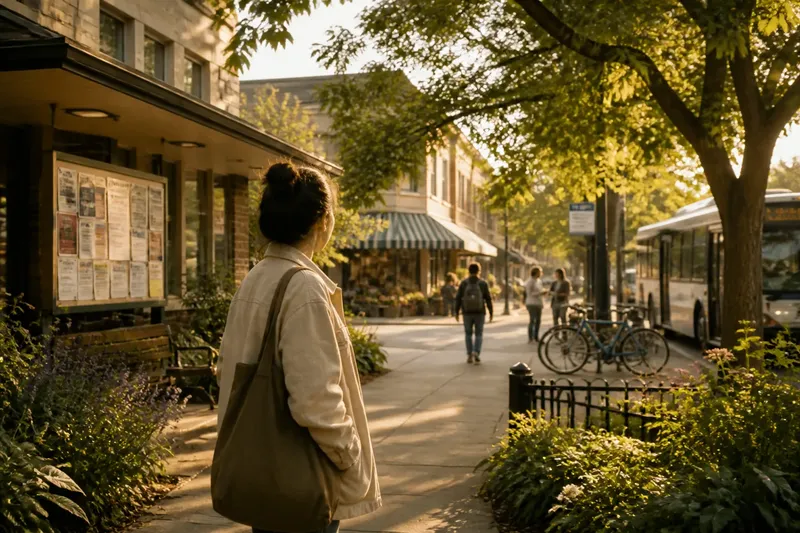
A first walk around an unfamiliar neighborhood is best taken at an unhurried pace, with room to follow a sound or linger at a corner. Look for the places where ordinary routines overlap: a shop doorway, a bus stop, a path beside a schoolyard. These small observations reveal how the neighborhood is used without requiring you to judge it or approach anyone.
Start with a soft route
Choose a simple loop that begins and ends somewhere easy to recognize, such as a transit stop, library, or main-street corner. Keep the route loose. A paper map or a saved map on your phone can help you find your way back, but there is no need to plan every turn in advance.
Walk on public sidewalks and paths, and let the street itself suggest where to go next. A stretch of storefronts may lead to a small park; a quieter residential block may bring you back toward a busier road. If a path looks private or a gate is closed, leave it alone and continue on the public route.
Notice how the neighborhood changes from one block to the next. Listen for the shift from traffic to birds, or from shop doors opening and closing to the softer sound of a residential street. These transitions are useful landmarks. They also help you understand where people seem to move through and where they tend to pause.
Notice where routines meet
A neighborhood’s shared life often appears at its edges rather than in a central gathering place. Watch for a bakery where people wait outside, a corner store with a few customers chatting near the entrance, or a community noticeboard beside a public building. The point is not to infer a whole story from one scene. It is to notice what kinds of everyday activity fit together in the same space.
Look at the timing as well as the setting. A playground may be quiet during a workday and lively after school. A café patio may draw people in the morning while the nearby bus stop stays busy later. If you pass again on another day, the contrast can show how a place changes with the neighborhood’s daily rhythm.
Small signs of use can be more revealing than decoration. A well-worn path across a grassy corner suggests that people have made a convenient route for themselves. A row of flowerpots outside several homes may hint at a shared habit, while chalk on a sidewalk might mark a recent game or event. Notice such details without assuming who created them or how long they have been there.
Read pauses and thresholds
Pay attention to the places where people slow down: a wide curb, a low wall beside a path, a sheltered entrance, or a spot where two sidewalks meet. These pauses may be brief. Someone could be checking a phone, waiting for a companion, or simply choosing which way to go. A single moment does not define a place, but repeated signs of stopping can show where the walk naturally breaks.
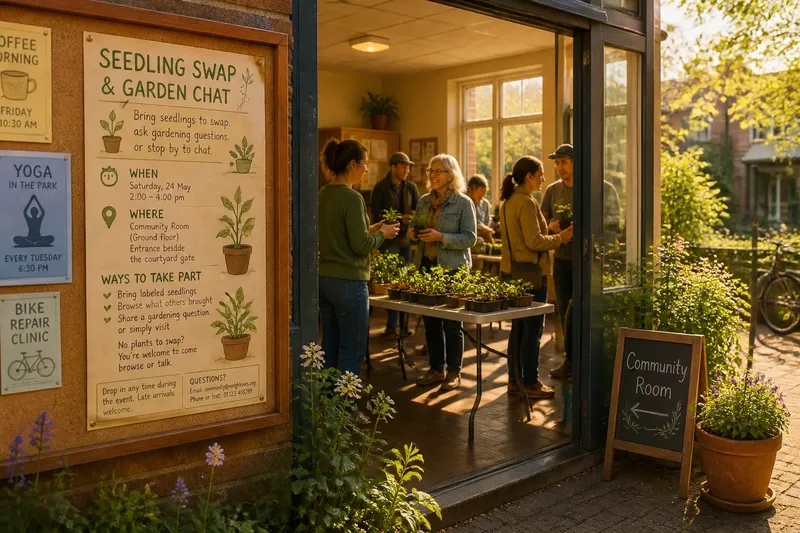
Doorways and boundaries tell their own quiet story. A shop with its door propped open feels different from one with a narrow entrance and a queue inside. A community center may have an open lobby, while a fenced garden has a clear entrance and posted hours. From the public side, observe how the boundary works: does it invite passersby to look in, direct them to an entrance, or signal that the space is reserved?
Imagine you have just moved near a small library and notice a broad path beside its entrance, a noticeboard under the awning, and a few people stopping to read it. You could pause at the public sidewalk, take in the posted events, and continue toward the nearby shops. The useful result is not a conclusion about the whole neighborhood; it is a clearer sense of how the library connects with the street.
Keep observation considerate
Let people remain people, not scenery. Avoid photographing strangers, looking into homes, or lingering beside a private entrance. If someone makes eye contact, a brief nod is enough; conversation can begin naturally if both people seem open to it. You do not need to collect names or personal details to learn the shape of a place.
Take care around children’s spaces, religious gatherings, and community events. These may be public-facing, but they still deserve respect. Follow signs, keep paths clear, and do not enter a gathering just to observe it. If you want to attend, check whether it is open to visitors and follow the host’s instructions.
A small notebook can help you remember the route, but keep notes about places rather than identifiable individuals. Record a useful landmark, a change in sound, or the location of a public noticeboard. Treat the page like a pocket map, not a report on the people who live there.
What should you notice?
Where do people naturally pause?
Look for sheltered corners, broad paths, shopfronts, and transit stops where people can wait without blocking others. Notice whether the pause seems brief or whether the setting invites someone to stay.
How do public places connect?
Trace the easy routes between a library, park, shop, and transit stop. Sidewalk continuity, crossings, and visible entrances can show whether these destinations feel linked on foot.
What changes with the hour?
Notice whether a place is quiet, occupied, or simply passing through at the time you visit. A return walk at another time can reveal a different use without requiring a new route.
How can you join in respectfully?
Start with public information: posted hours, event notices, or a clearly open gathering. If the invitation is unclear, ask an organizer or staff member rather than assuming that a visible activity is open to everyone.
Let the route stay open
There is no need to turn a first walk into a full inventory. Choose one detail to carry away: the route people take toward the park, the public noticeboard by the library, or the corner where the street becomes quiet. On another day, follow a different block or return at a different hour.
That is enough to make a place less unfamiliar. A first walk around an unfamiliar neighborhood works best as an invitation to pay attention, not a test of how much you can identify. If you remember one public place and one small sign of how neighbors use it, you have a useful starting point for your next visit.